
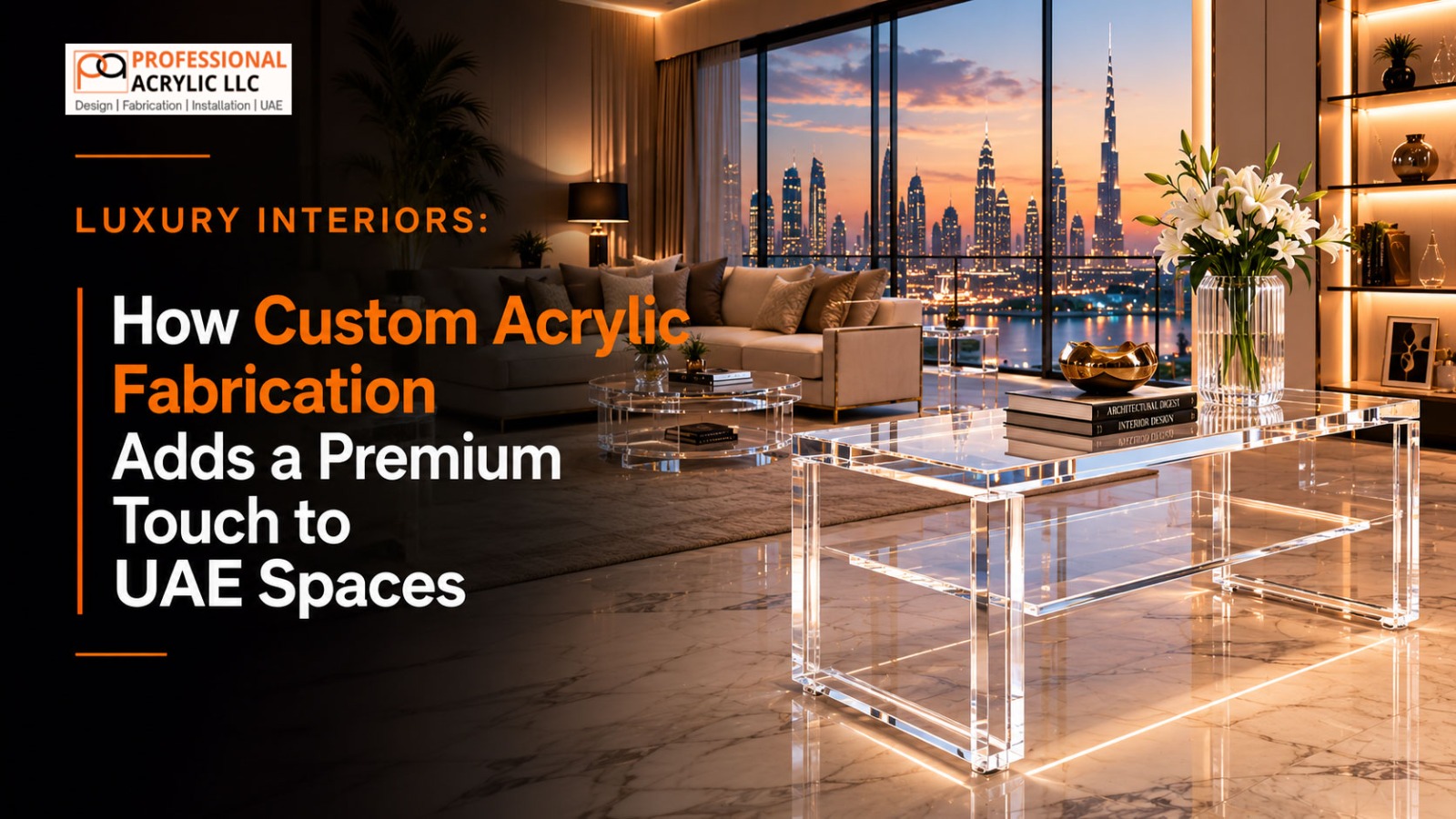
Luxury Interiors: How Custom Acrylic Fabrication Adds a Premium Touch to UAE Spaces
Walk into almost any newly fitted-out hotel lobby, flagship retail store, or high-end residence in Dubai today, and there’s a good chance acrylic is doing some of the visual heavy lifting – even if nobody notices it directly. A floating reception counter, a backlit display wall, a set of sculptural shelves holding a perfume collection, a curved staircase balustrade that catches the light instead of blocking it. Acrylic has quietly become one of the go-to materials for designers who want a refined, modern look without the weight, cost, or fragility of glass.
This article looks at how custom acrylic fabrication actually works in luxury interior projects across the UAE, where it makes the most sense, what to consider before specifying it, and how the fabrication process affects the final result you hand over to a client.
What Makes Acrylic Suitable for Luxury Interiors?
Acrylic suits luxury interiors because it combines glass-like clarity with far greater design flexibility. It can be cut, curved, bonded, and finished into shapes that would be difficult or expensive to achieve in glass or metal, while staying lightweight, resistant to impact, and easy to keep looking clean over time.
For interior designers and architects, this flexibility matters more than the material’s clarity alone. Acrylic sheet can be heated and formed into curves, domes, and radial shapes that glass simply cannot achieve without specialist tooling and significant cost. It can be laser-cut or CNC-routed into precise patterns for perforated panels, logo signage, or decorative screens. It can be tinted, frosted, or custom-painted to match an exact brand colour rather than settling for whatever stock tint happens to be available.
There’s also a practical side that rarely gets discussed in design conversations but matters a great deal on-site: acrylic is roughly half the weight of glass at equivalent thickness. That makes a real difference when a reception counter, a suspended display case, or a large decorative panel needs to be installed above floor level, transported through a tight service corridor, or fixed to a wall that wasn’t built to carry heavy structural glass.
How Is Acrylic Used in High-End Interior Design?
In UAE interiors, acrylic tends to show up in two broad ways: as furniture and fixtures people interact with directly, and as architectural or decorative features that shape how a space feels.
On the furniture side, this includes coffee tables, console tables, dining chairs, and side tables fabricated from thick cast acrylic – often 15mm to 25mm – which gives the piece enough structural presence to stand on its own rather than needing a hidden frame. On the architectural side, it includes staircase balustrades, column cladding, decorative ceiling panels, backlit wall features, and reception desks where the acrylic itself becomes the visual statement rather than a supporting material.
What separates a well-executed acrylic interior feature from a generic one usually comes down to three things: the thickness and grade of acrylic selected for the application, the quality of the joints and bonding, and the finishing – whether that’s a polished edge, a frosted surface, or a custom paint colour that was mixed to match a brand’s exact palette rather than approximated.
What Are the Best Acrylic Applications for Luxury Interiors?
The applications that tend to work best in premium UAE interiors share a common thread: they use acrylic’s clarity, formability, or light-transmitting properties to solve a specific design or functional problem, rather than using acrylic simply because it’s available.
Reception counters and front desks – acrylic allows for a clean, monolithic look, often combined with backlighting or a contrasting material like brushed metal or stone for the counter surface.
Retail and product display units – jewellery cases, perfume shelving, and cosmetics displays benefit from acrylic’s clarity, which keeps visual focus on the product rather than the fixture.
Decorative panels and column cladding – used in hotel lobbies and restaurants to add texture or a lit feature wall without the structural load of stone or glass.
Staircases and balustrades – solid acrylic handrails and panels bring a modern, open feel to a stairwell that would otherwise feel visually heavy in metal.
Domes and skylights – UV-resistant acrylic is commonly used for architectural domes and skylights that need to admit natural light while managing weight and installation complexity.
Sculptural and bespoke pieces – one-off installations, branded signage, and artistic display structures where the design brief calls for something that doesn’t exist as a standard product.
Lighting elements – acrylic diffuses and channels light well, which makes it a practical choice for backlit signage, edge-lit panels, and decorative fixtures.
Each of these works because the fabrication is built around the specific requirement – a display case needs different wall thickness and bonding than a load-bearing balustrade, and a backlit panel needs a different finish than a polished tabletop.
Are Acrylic Shelves Suitable for Premium Retail and Hospitality Spaces?
Yes. Acrylic shelves are widely used in premium retail and hospitality settings because they hold products without visually competing with them, and because they can be shaped to fit an exact display concept rather than a standard fixture size.
In a luxury retail environment – a jewellery boutique, a perfume counter, a concept store – the display itself is part of the brand experience. Acrylic shelving lets a designer create a floating or near-invisible support structure, so the product appears to hang in space rather than sit on an obvious shelf. This is achieved through careful thickness selection (thin enough to look light, thick enough to carry the load) and clean edge-polishing, since any visible imperfection is far more noticeable on a piece meant to look weightless.
In hospitality settings, custom acrylic shelving shows up in bars, amenity displays, and retail corners within hotels, where the same principle applies the fixture should support the brand’s visual language rather than distract from it. Because each shelf is fabricated to the exact dimensions of the space and the products it needs to hold, this is one of the clearest cases where custom acrylic fabrication outperforms anything bought off the shelf.
Why Choose Custom Acrylic Fabrication Instead of Ready-Made Products?
Ready-made acrylic products are built to standard sizes and generic finishes, which rarely match the exact dimensions, colour palette, or design intent of a luxury interior project. Custom fabrication lets designers specify thickness, shape, colour, and finish precisely, and adapt the piece to real site conditions rather than forcing the site to accommodate a stock item.
This matters more in the UAE than in many markets, because a large share of premium interior work here is bespoke by nature, a hotel doesn’t want the same reception counter as its competitor down the road, and a retail brand’s flagship store is usually designed around a specific concept that a catalogue product won’t fit. Custom fabrication also solves practical problems: an odd-shaped alcove, a non-standard ceiling height, an existing structural column that needs cladding, or a colour that has to match a brand guideline exactly rather than approximately.
There’s a cost and time trade-off worth being upfront about, custom work takes longer to design, quote, and produce than pulling a ready-made unit off a shelf. But for a project where the finish and fit genuinely matter, that lead time is usually a reasonable exchange for getting a result that fits the space and the brief, rather than one that fits neither.
How Does Acrylic Compare With Glass in Interior Design?
Both materials offer transparency and a premium look, but they behave differently in fabrication, installation, and daily use. The table below outlines the practical differences that matter most for interior specification.
| Factor | Acrylic | Glass |
| Weight | Roughly half the weight of glass at the same thickness | Heavier, requires stronger fixings and support |
| Formability | Can be heat-formed into curves, domes, and complex shapes | Curved glass is possible but far more specialised and costly |
| Impact resistance | More resistant to shattering on impact | Can shatter into sharp fragments if broken |
| Custom colour/finish | Can be custom-painted, tinted, or frosted to an exact match | Colour and finish options are more limited without specialist glass processing |
| Edge finishing | Polished, bevelled, or seamlessly bonded edges achievable in-house | Typically requires specialist glass finishing |
| Surface hardness | More prone to surface scratching than glass | More scratch-resistant on the surface |
| Best suited for | Custom shapes, lightweight installations, backlit features, bespoke furniture | Large flat panels, structural glazing, high-traffic contact surfaces |
Neither material is a universal replacement for the other the right choice depends on the application. A backlit reception feature or a curved display case is usually a better fit for acrylic; a large structural storefront window is usually better suited to glass. Many UAE interior projects end up using both, in the areas where each performs best.
What Should Designers Consider Before Specifying Acrylic?
Before specifying acrylic for a luxury interior element, it’s worth thinking through material grade, thickness, finish, and how the piece will actually reach and sit in the space.
Thickness and grade should match the load and visual weight required – a tabletop needs different thickness than a decorative panel, and cast acrylic behaves differently from extruded acrylic under heat-forming. Finish needs to be decided early, since polished, frosted, and painted finishes each require a different fabrication approach and affect how joints and edges are handled. Colour matching, particularly for branded retail or hospitality projects, should be confirmed against physical samples rather than digital references, since acrylic can read differently under different lighting conditions.
Site conditions and installation access also deserve attention before the design is locked in. A large one-piece acrylic panel that looks perfect on a drawing can become a logistical problem if it doesn’t fit through a service lift or a standard doorway, which is why experienced fabricators often flag panel sizing and joint placement early in the process rather than after production has started. Finally, maintenance expectations are worth setting with the client upfront – acrylic is easy to clean but can scratch with abrasive materials, so care instructions matter, especially in high-traffic hospitality or retail settings.
How Does the Acrylic Fabrication Process Work?
A well-run custom acrylic fabrication process moves through design, material selection, shaping, assembly, finishing, and installation with each stage affecting how the final piece looks and performs in a luxury interior setting.
Design and specification. The process starts with drawings or a design brief from the architect, interior designer, or client, defining dimensions, intended finish, and how the piece will be used or installed.
Material selection. The right acrylic type and thickness is chosen based on the application, a structural balustrade panel needs different material than a lightweight display shelf.
Cutting and routing. Sheets are cut to size using precision cutting equipment, with routing used to create edges, cut-outs, or joinery details.
CNC machining and laser processing. For intricate patterns, engraved logos, or components that need exact repeatability across multiple units, CNC and laser techniques allow for controlled fabrication that would be difficult to achieve by hand alone.
Bending and molding. Where a curve, dome, or radial shape is required, acrylic is heated and formed a stage that calls for real fabrication experience, since uneven heating shows up immediately in the finished surface.
Bonding and assembly. Individual components are joined using chemical bonding techniques suited to acrylic, aiming for joints that are structurally sound and, where the design calls for it, close to invisible.
Polishing and finishing. Edges are polished, surfaces are treated (frosted, painted, or left clear), and any final detailing is applied to bring the piece to its intended finish.
Quality checking. Finished pieces are checked against the original specification for dimensions, finish quality, and structural integrity before leaving the workshop.
Delivery and site installation. For larger architectural pieces, this stage includes coordinating access, protecting the piece in transit, and fitting it on-site to match design intent and any relevant safety requirements.
Each stage matters because acrylic is unforgiving of shortcuts in a way that’s often invisible until the piece is installed under the interior’s actual lighting. A slightly uneven polish or an imperfect bond line that wouldn’t matter on a utilitarian piece becomes obvious on a feature reception counter lit from below.
Why Team Expertise Matters as Much as the Machinery
CNC routers, laser cutters, and thermoforming equipment can produce accurate, repeatable cuts, but the equipment alone doesn’t decide how a joint sits, how a curve reads under light, or whether a finish matches the sample approved months earlier. That comes down to the people running the process.
Experienced acrylic fabricators develop a feel for how the material behaves that doesn’t show up in a spec sheet: how much a sheet will move during heat-forming, how a bonded joint will cure under different ambient conditions, how a polished edge will catch light differently depending on the thickness of the piece. They also understand fabrication tolerances, how much room to build into a design so that a large panel still fits together cleanly on-site, even with minor variances that are normal in any construction environment.
This is also where coordination between designer, fabricator, and contractor becomes practical rather than theoretical. A design intent drawn in a 3D render doesn’t always translate directly into a buildable piece, and an experienced fabrication team is usually the one that flags a dimension, a joint location, or an installation sequence that needs adjusting before it becomes a site problem. On multi-trade fit-out projects, where acrylic elements need to align with electrical work for backlighting, structural fixings, or adjacent finishes, this kind of practical back-and-forth between teams is often what determines whether an installation goes smoothly or runs into delays.
Where Custom Acrylic Fabrication Fits Into UAE Interiors
Custom acrylic fabrication shows up across a wide range of UAE commercial and residential projects, and the reasons it gets specified tend to be specific to each sector rather than generic.
Luxury retail relies on acrylic for display cases, shelving, and fixtures that need to showcase product without competing visually for attention – a common requirement in jewellery, perfume, and fashion retail across Dubai’s malls and standalone boutiques.
Hospitality – hotels, resorts, and restaurants – uses acrylic for reception features, bar counters, decorative panels, and lighting elements where the material’s ability to be backlit or custom-coloured supports a specific interior concept. Restaurants in particular often use acrylic for branded signage and feature walls that need to hold up to daily cleaning without losing their finish.
Commercial and corporate spaces use acrylic for reception desks, branded signage, meeting room partitions, and 3D logo installations – applications where a clean, modern look matters and the piece needs to reflect a company’s brand identity precisely.
Exhibition and events companies frequently specify custom acrylic for display stands, product risers, and temporary structures, where the ability to fabricate quickly to an exact brief matters as much as the finished look.
Premium residential projects use acrylic for staircases, furniture, and decorative features where designers want a lighter, more contemporary alternative to glass or heavy stone detailing.
Architectural and fit-out contractors work with acrylic fabricators for domes, skylights, and larger structural or semi-structural features that need both design input and an experienced on-site installation team to execute properly.
Across all of these sectors, the common requirement is the same: the piece needs to be built to the exact dimensions and design intent of that specific project, not adapted from something that was built for someone else.
Why Choose Professional Acrylic for Custom Interior Projects in the UAE?
Professional Acrylic brings 20+ Years Experience in Acrylic Fabrication to interior projects across Dubai and the wider UAE, working directly with designers, architects, and contractors from initial concept through to on-site installation.
The company’s fabrication capabilities cover the full process an interior project typically needs – cutting and routing, chemical bonding, molding and bending, polishing, and custom painting for colour-matched finishes – supported by a dedicated on-site installation team for projects that require fitting on location rather than simple delivery. This range matters for interior work specifically, because a single project often needs several of these processes combined: a reception counter might need routing, bonding, polishing, and a custom paint finish before it’s ready to leave the workshop.
Beyond the equipment, the team’s experience shows up in how it works with clients – taking a design brief or set of specifications from an architect or interior designer and translating it into a fabricated piece that matches the original intent, while flagging practical considerations around dimensions, joints, and installation along the way. That combination of technical capability and hands-on fabrication experience is what allows the company to take on bespoke, one-off interior pieces rather than only standard catalogue items.
Client feedback also reflects this approach to custom, long-term project work. As one Dubai-based interior design client, KNOB Interiors, noted in a review: they had worked with Professional Acrylic since 2012, describing the team as consistently responsive and willing to go the extra mile on specific project needs, alongside professional on-site installation service.
Working With an Acrylic Fabrication Partner on Your Next Project
Custom acrylic fabrication works best when it’s brought into a project early – during design development rather than after drawings are finalised – so that material selection, finish, and installation logistics can be planned around the actual space rather than adjusted after the fact.
If you’re an architect, interior designer, fit-out contractor, or retail or hospitality business planning a UAE project that could benefit from bespoke acrylic elements, it’s worth discussing the brief with a fabricator directly. A short conversation about dimensions, finish, and timeline early on tends to save both time and revisions later. Professional Acrylic works with design and project teams across Dubai and the UAE on everything from a single custom display piece to full interior fit-out packages, and is available to talk through a specific brief or site requirement.
FAQ Section
What is acrylic fabrication in interior design?
Acrylic fabrication is the process of shaping raw acrylic sheet into finished interior elements – such as furniture, shelving, panels, or display units – using techniques like cutting, routing, heat-forming, bonding, and polishing to match a specific design brief.
Is acrylic suitable for luxury interiors?
Yes. Acrylic offers glass-like clarity with more design flexibility, lighter weight, and the ability to be custom-shaped, coloured, and finished, which makes it a practical material for high-end reception areas, retail displays, furniture, and architectural features.
What can be custom fabricated from acrylic?
Common examples include reception counters, shelving and display units, tables and chairs, decorative panels, staircase balustrades, domes and skylights, lighting elements, signage, and bespoke sculptural pieces.
Are acrylic shelves suitable for retail interiors?
Yes. Acrylic shelves are widely used in premium retail settings because they can be fabricated to an exact size and finish, and their clarity keeps visual attention on the product rather than the fixture itself.
Can acrylic be customized to match an interior design?
Yes. Thickness, shape, tint, and finish can all be specified, and colours can be custom-painted to match a brand palette or design scheme rather than relying on standard stock tints.
How long does custom acrylic fabrication take?
Timelines vary depending on the complexity of the piece, the finishes required, and whether on-site installation is involved. Simple items can be produced quickly, while large architectural features or multi-piece installations need more design and production time – it’s best discussed against your specific project timeline.
What is the difference between acrylic and glass for interiors?
Acrylic is lighter, more impact-resistant, and easier to shape into curves or custom forms, while glass is more scratch-resistant and remains the standard choice for large structural glazing. Many interior projects use both, depending on the application.
Can Professional Acrylic handle installation in Dubai?
Yes. Professional Acrylic has a dedicated on-site installation team that handles fitting and assembly for custom acrylic structures across Dubai and the wider UAE, in addition to workshop fabrication.